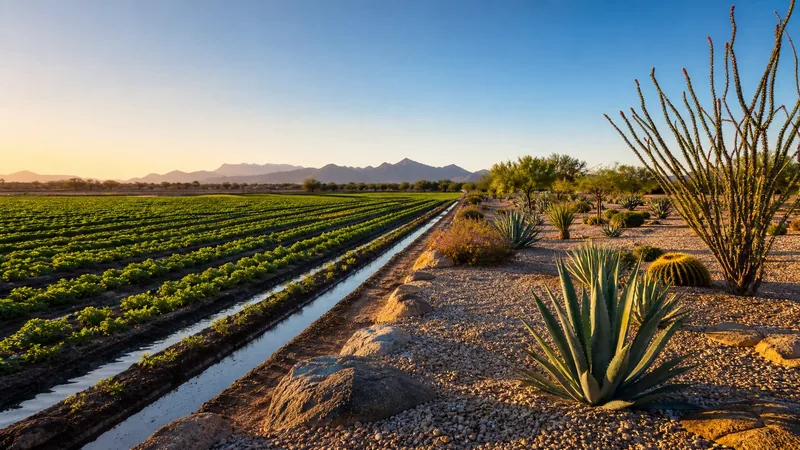
How to Start a Farm in Arizona: Yuma Produce, Dept of Agriculture and Water Rights
How to Start a Farm in Arizona: Yuma Produce, Dept of Agriculture and Water Rights
Starting a farm in Arizona means lining up several separate pieces, and the order matters. You form the business with the Arizona Corporation Commission, register for the Transaction Privilege Tax (TPT) with the Department of Revenue, confirm which Arizona Department of Agriculture programs apply to your crop, and check water rights before you commit to land. A farm that buys acreage first and checks water later can end up with a parcel it cannot irrigate the way it planned. This guide follows the steps in the order we would handle them.
This article is informational content, not legal or tax advice. Water, agriculture, and tax rules change, and your situation may call for a qualified Arizona attorney and a CPA who works with farms. Confirm every figure below on the official agency page before you pay or file.
What you need before you start
Gather these items early, because most of them come up at more than one step.
- A business name checked against the Corporation Commission business search at arizonabusinesscenter.azcc.gov/businesssearch
- A statutory agent with a permanent Arizona address, or an Arizona entity willing to serve as your agent
- Proof of land access, such as a recorded deed, a recorded lease, or a purchase contract made conditional on water review
- Every water document the seller holds for the parcel, including well records and any irrigation district information
- A crop and market plan that names your planned acreage, crops, and first buyers
- A federal employer identification number (EIN), which the IRS issues directly rather than a state agency
- An equipment list with purchase prices, since some machinery may fall under the tax exemption in Step 5
Step 1: Decide what you will grow and who will buy it
Your crop decides which state program applies, whether buyers will require food safety membership, and how your sales are taxed. A winter leafy greens operation in Yuma sells into a very different buyer chain than a summer vegetable stand in Tucson. Write a one-page plan that answers three questions: what you will grow, how much land and water it needs, and whether you will sell wholesale, at retail, or both. Retail sales and processed products are taxed differently, so the third answer matters later.
Do not finalize the crop list until Step 2 is complete. Water limits what you can irrigate, and a crop plan built on land you cannot water is not a plan.
Step 2: Check water rights before you buy land
Water is the step new growers most often underestimate. Arizona's water rules depend on where the land sits, so check the location first.
- Active Management Areas: Under A.R.S. 45-452, new irrigated acreage generally cannot be added in an Active Management Area. A parcel that was never irrigated may not be usable for crops there.
- Irrigation non-expansion areas: Under A.R.S. 45-437, irrigation is limited to land irrigated between 1975 and 1980. Fields outside that window generally cannot be brought into irrigation.
- Colorado River and CAP supply: Supply cuts affect farms in central Arizona. Ask for the actual Central Arizona Project or irrigation district contract attached to the parcel, not a general description of the district.
Before you sign anything, ask the Arizona Department of Water Resources (ADWR) at azwater.gov to confirm in writing what groundwater and surface water rights attach to the parcel. Do not rely on the seller's description, a broker's summary, or what a neighbor has pumped for years. Make the purchase contract conditional on that written confirmation, and have an attorney review the language.
Step 3: Choose your business entity
Most small farms choose between an LLC and a for-profit corporation. The Arizona Corporation Commission, Corporations Division, handles both filings. The figures below matter most at formation.
| Item | LLC (Articles of Organization, Form L010) | For-profit corporation (Articles of Incorporation) |
|---|---|---|
| Filing fee | $50 | $60, filed together with a Certificate of Disclosure |
| Expedited review | $85 total ($35 above the regular fee) | Confirm the option on the Commission site |
| Annual report | Not required | Required each year, $45 fee |
| Income tax | Income passes through to members, who pay the flat 2.5% individual rate, unless the LLC elects corporate treatment | Corporate income tax of 4.9% of net income or $50, whichever is greater |
The table is a starting point, not tax advice. Many farms choose an LLC because it has no annual report at the Commission, but members still owe state income tax on their share of profit, and the business still needs a TPT license if it makes taxable sales.
Formation steps
- Reserve the name if you need time. A name reservation costs $10 and holds the name for 120 days.
- Use the required name words. An LLC name must contain 'limited liability company' or 'limited company', or L.L.C., L.C., LLC or LC. It must not contain 'association', 'corporation', 'incorporated' or an abbreviation of those words. Names with banking or trust terms, such as bank, trust or credit union, need prior written approval from the Arizona Department of Financial Institutions.
- Appoint a statutory agent. An individual agent must be a permanent, full-time Arizona resident with a permanent, full-time physical or street address in Arizona. An entity can serve if it is authorized to transact business in Arizona, but an LLC cannot be its own agent. The agent must accept the appointment in writing on Statutory Agent Acceptance form M002.
- File online. Use the Arizona Business Center at arizonabusinesscenter.azcc.gov, and review the Commission's filing guidance at azcc.gov/corporations.
- Plan for publication. An LLC must publish notice unless its statutory agent's county is Maricopa or Pima. An agent in Yuma County, or in any other county outside those two, means you must publish. Confirm the timing, rules and cost with the Commission before you budget for it.
- Keep the agent in place. An entity must keep a statutory agent with a valid address on record at all times, or risk administrative dissolution under A.R.S. 29-3708. Changing the agent or principal address costs $5 for an LLC.
Posted processing times as of December 29, 2025 run about 9 to 11 business days for regular processing and 2 to 4 business days for expedited processing. Accelerated service is charged on top of the filing fee: $100 for next-day service (received by 5pm), $200 for same-day service (received by 10am), and $400 for two-hour service (available 8am to 3pm). Accelerated service guarantees examination within the stated window, not approval. Confirm current times before you file.
Step 4: Register a trade name if you sell under a different name
If your farm stand, CSA, or brand will sell under a name other than your entity name, register a trade name with the Arizona Secretary of State, Business Services Division, at azsos.gov/business/tntm. Trade name registration is optional in Arizona and is separate from your Corporation Commission filing. This guide does not list the trade name fee, so confirm it on that page.
Step 5: Register for the TPT license and check farm exemptions
Arizona has no general state business license. The license most farms need is the Transaction Privilege Tax license from the Arizona Department of Revenue, which is required for retail sales and other taxable business classifications. It costs $12 per location. Apply at azdor.gov/business/transaction-privilege-tax/tpt-license.
The combined state TPT rate on retail and most other taxable classifications is 5.6%, and county and city rates apply on top of it. Under A.R.S. 42-5061, the following are exempt when used for commercial production:
- Seed, fertilizer, pesticides, and other propagative materials
- Livestock feed and livestock
- Farm machinery, such as tractors and drip irrigation lines
These exemptions cover inputs for production. They do not cover everything you sell. If you process products and sell them at retail, the retail classification applies to those sales, so bottled or packaged goods should be treated differently from raw produce sold wholesale. Ask the Department of Revenue which records support each exemption, and keep them from your first purchase.
Step 6: Find the Arizona Department of Agriculture program that fits your crop
The Arizona Department of Agriculture at agriculture.az.gov regulates produce safety, nursery, and other farm programs. Each covers a different part of the operation, so do not assume one registration covers everything. Find the program that matches your crop, then call program staff before you plant or build a packing area. Ask whether your washing, cooling, packing, or storage steps fall under a produce safety program, and whether you need a license for any nursery stock or other products you plan to sell.
Step 7: Plan for Yuma winter leafy greens buyers
If you grow leafy greens in the Yuma area, learn the Arizona Leafy Greens Marketing Agreement early. It is a voluntary, state-certified agreement for shippers, certified in 2007 and updated in 2023. Members follow metrics-based food safety rules, verified through USDA-licensed audits. The agreement is voluntary, but many buyers require member handlers, so membership may be a condition of a sale. Ask buyers in writing whether membership is required before you commit to a planting plan, and confirm the current membership process and audit costs with the Department of Agriculture.
Step 8: Check city licenses and contractor rules
Counties issue no general business license, so a county permit does not replace the TPT license or the state filings. Cities and towns, however, commonly require their own business or TPT license on top of the state license. A farm stand inside city limits and a packing shed outside them may need different answers, so confirm the rules for each address with that city or town's clerk or tax office.
If you plan to build a packing shed, cold room, or other structure, the Registrar of Contractors licenses contractors in Arizona. Hire a licensed contractor, verify the license with the Registrar, and ask whether any licensing applies to your specific structure. Do not assume a farm building is exempt because it is agricultural.
Step 9: Get advice from people who work with small businesses
The Arizona Small Business Development Center Network (AZSBDC) at arizonasbdc.com can help with business planning, and the SBA's Arizona district page at sba.gov/district/arizona lists local resources. Neither replaces an attorney or CPA. An attorney should review your entity choice, land contract, and agent arrangement. A CPA should review your TPT exemption records and tax treatment.
What to expect when the paperwork is done
If the steps go to plan, you may end up with a formed entity, a TPT license, a list of the agriculture programs that apply to your crop, and written water confirmation for your parcel. Based on posted processing times, a regular LLC filing may take about 9 to 11 business days and an expedited filing about 2 to 4 business days. Those windows are not guarantees, and they do not cover publication, buyer approvals, or settling land and water questions.
This guide cannot promise a particular yield, price, buyer relationship, or profit. Those depend on your soil, water supply, crop choice, market access, and management, and they change from season to season.
Common mistakes to avoid
- Buying land before you have written ADWR confirmation of its water rights.
- Assuming a county business license covers you. Counties generally issue none, and cities may require their own.
- Overlooking publication for an LLC whose statutory agent is outside Maricopa and Pima counties.
- Letting the statutory agent lapse, which can lead to administrative dissolution.
- Forgetting the $45 annual report if you form a corporation.
- Treating every purchase as exempt. Exemptions are tied to commercial production, and retail sales of processed products fall under the retail classification.
- Planting before you know whether your buyers require leafy greens membership.
Tips that save time
- Run the water check and the crop plan side by side, since each one changes the other.
- Check fees and processing times on the official pages on the day you act, because they change.
- Choose an agent with a stable Arizona address you will keep for years, so you do not have to change it.
- Open the bank account in the entity name once the filing is approved, so money in and out stays clean.
Next steps
Start with the water question, then the entity, then the TPT license and agriculture program. Keep a dated record of each filing, and bring the completed plan to your attorney and CPA before you sign land or buyer contracts.
Disclaimer: This article is informational content only. It is not legal, tax, or water rights advice. Consult a qualified Arizona attorney, a CPA, and the relevant agencies before making decisions about your farm.